
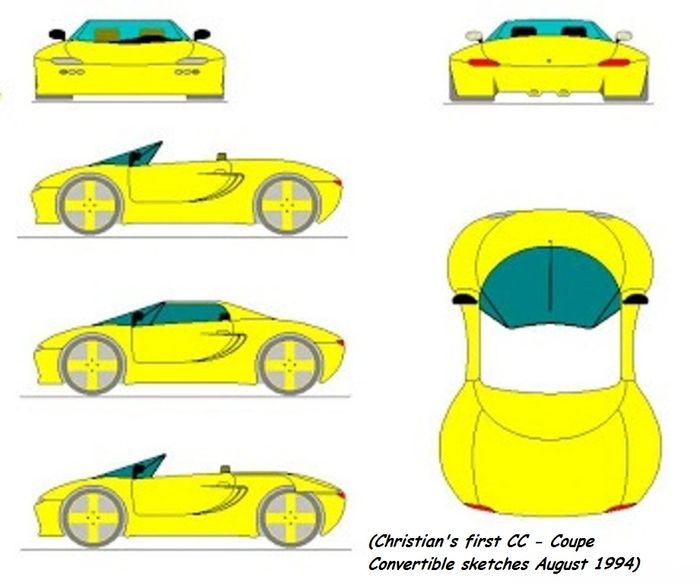
The project began with Christian von Koenigsegg showing him his original design he drew on his Commodore 64® and later on the Agima 1000® computer. Mr. Crafoord then penned down his ideas and designed a 1:5 ratio model of the car based on Christians ideas. He took inspiration from nature for aerodynamics and ultimately reach to one of the most humble animals in the world for the design - a dolphin.
The original design according to Christian was that the car was supposed to be both a Targa and a convertible all in one and offered as a single product rather making two different version. However, due to the complexities encountered, this idea was dropped with Christian and Crafoord settling on the Targa style as the only option to go with. Koenigsegg then insisted on a removable top that could be stored – a unique concept in its time which added the pressures of storage space to the equation. The cockpit too was inspired by the Le Mans Porsche® but where the LM Porsche® was designed as a single seater cockpit, the Koenigsegg had to be a dual seater. Naturally, a larger cockpit had to be made. The corners of the car would become rounder as he sketches. The lines start to flow and they can visualize how air would flow across the fenders, slip past the windscreen, and channel into the flush rear spoiler. The targa roof split shape is what Crafoord describes it as “Dolphins breaking the water wave”. The important thing to note was that the car had to be designed to a timeless piece of art. Something that would be void of the design elements that would age the design quickly. Elements such as fins, flares or other gimmicks that would date the design quickly were all avoided.
The car was basically two symmetrical squares with an ovoid sphere in the centre. A very simple and elegant design but a lot of thought was put into it. Especially the double bubble rear roof lining which was created to ensure a low pressure region and downforce would be generated. However this turned out to be very tricky as there was no way to make a glass with such extreme curves at the time. So Crafoord decides to put in a small sectional window with the rear panel of the roof being glass as well also creasing between the two roof bubbles eliminating the clustered feeling and giving some rear visibility.
Photo credit: Christian von Koenigsegg
Rights to Koenigsegg®
